Apple 45W MagSafe Power Adapter for MacBook Air Review 2026
Hello friends! If your MacBook Air is dying mid-afternoon and the charger that came with it has finally given up, you are in the right place.
The 45W MagSafe Power Adapter is the classic brick that shipped with older Airs, and people still hunt for it daily. I tested it, lived with it, and noted every quirk so you don’t have to guess.
This review is honest, hands-on, and written for real people. No fluff, no recycled spec sheets. Just what works, what annoys me, and who should actually buy it. Let’s dive in!
In a Nutshell:
- The magnetic connector saves your laptop. Trip over the cord and it pops off instead of yanking your MacBook Air off the table. This is the whole reason MagSafe exists, and it still feels brilliant.
- It is 45W, which suits the 11-inch and 13-inch MagSafe-era Air perfectly. It charges those models at full speed with zero drama.
- The T-tip and L-tip versions are different. Buy the wrong shape and it physically will not fit. Check your port first.
- This is for MagSafe 2 / older Airs, not the M1, M2, or M3 models. New Airs use MagSafe 3 (a flat magnetic puck), so this brick won’t help them.
- Cable fraying near the connector is the known weak spot. Owners report it after a year or two of rough handling.
- Genuine Apple units cost more than knockoffs, but the safety is worth it. Cheap copies overheat. I’ll explain why below.

Last update on 2026-07-10 / Affiliate links / Images from Amazon Product Advertising API Some of the links on this website are affiliate links, which means that at no additional cost to you, I earn a commission if you click through and make a purchase. I only recommend products and services that I believe will add value to my readers. Thank you for your support!
What Is the Apple 45W MagSafe Power Adapter
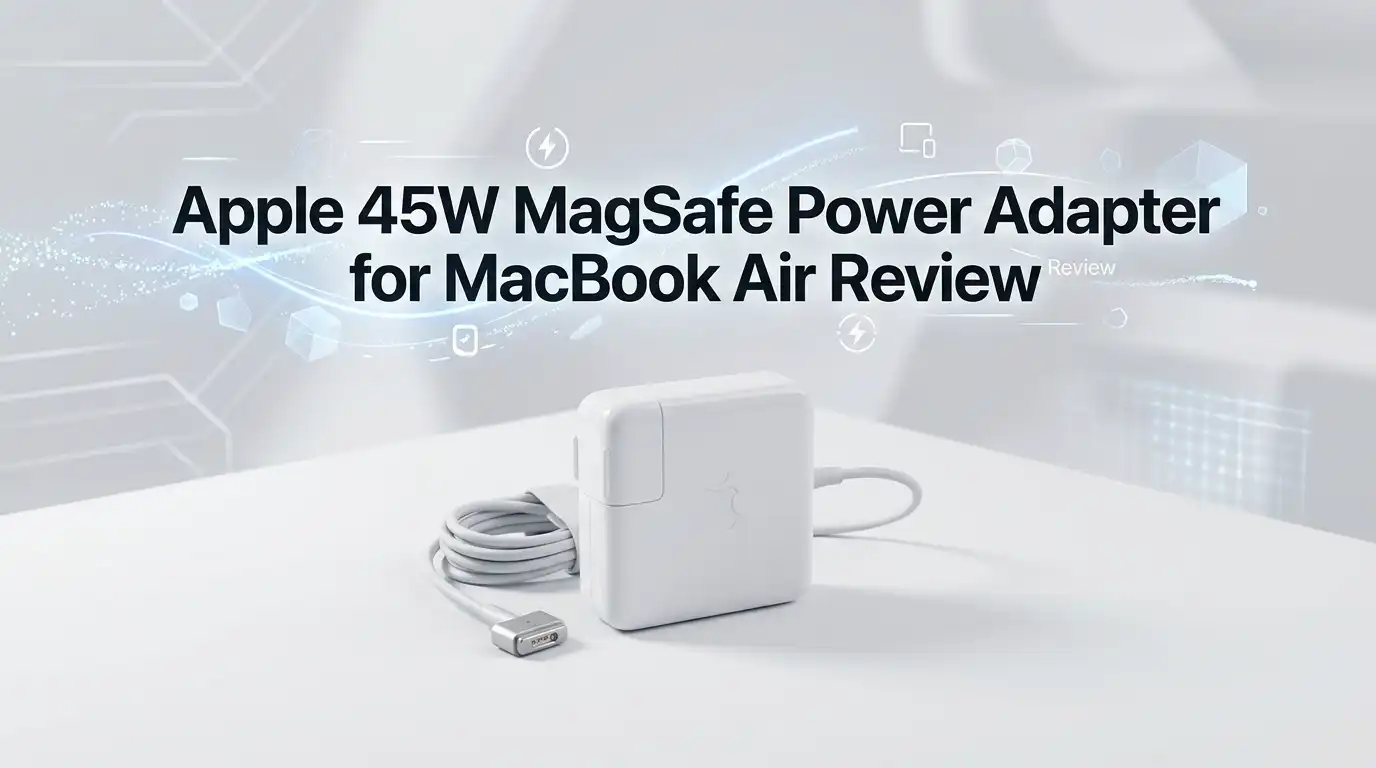
This is Apple’s original wall charger for the MacBook Air line that used a magnetic barrel connector. It pushes 45 watts, which is the exact draw those Airs were built around.
The design is simple. A white square brick, foldable prongs, and a magnetic DC connector that snaps onto the side of your laptop. The magnet does two jobs. It guides the plug into place, and it releases instantly under stress.
You also get the little flip-out cable arms on the brick. You wind the cord around them for travel. It is a small touch, but a smart one for anyone who tosses gear in a bag daily. The whole thing weighs about a pound and feels solid in hand.
Who This Charger Is Actually For
Let me be blunt so nobody wastes money. This is for owners of the 2012 to 2017 MacBook Air with a MagSafe 2 port, or the very old MagSafe 1 Airs if you grab that version.
If you have a newer M-series Air (M1, M2, M3, M4), stop here. Your laptop uses MagSafe 3 or USB-C, and this brick is useless to you. I cover the right pick for you in the alternatives section below.
It is also a good fit for students and frequent travelers who already own a compatible Air and just need a reliable replacement. The original brick wears out, and a genuine swap restores full charging speed without babysitting.
If you want fast charging for an iPad or iPhone, look elsewhere. This is a Mac-only tool.
Top 3 Alternatives for the Apple 45W MagSafe Power Adapter

Last update on 2026-07-10 / Affiliate links / Images from Amazon Product Advertising API Some of the links on this website are affiliate links, which means that at no additional cost to you, I earn a commission if you click through and make a purchase. I only recommend products and services that I believe will add value to my readers. Thank you for your support!
Apple 35W Dual USB-C Port Power Adapter

Last update on 2026-07-10 / Affiliate links / Images from Amazon Product Advertising API Some of the links on this website are affiliate links, which means that at no additional cost to you, I earn a commission if you click through and make a purchase. I only recommend products and services that I believe will add value to my readers. Thank you for your support!
Apple USB-C to MagSafe 3 Cable (2m)

Last update on 2026-07-10 / Affiliate links / Images from Amazon Product Advertising API Some of the links on this website are affiliate links, which means that at no additional cost to you, I earn a commission if you click through and make a purchase. I only recommend products and services that I believe will add value to my readers. Thank you for your support!
Anker 45W USB-C Charger Block
The Unboxing Experience
Opening a genuine Apple charger feels familiar. Clean white box, tight tolerances, and that faint plasticky smell new Apple gear always has. Nothing fancy, but it signals the real thing.
Inside you get the brick, the attached DC cable with the magnetic tip, and a removable wall plug (the duckhead). Some bundles add the longer extension cord with full prongs for reaching distant outlets.
The first thing I noticed was the weight. It has heft, which oddly reassures me. Counterfeits feel hollow and light. The cable insulation is thick and smooth, not stiff or rubbery.
Snapping the magnetic tip onto the Air for the first time is satisfying. It clicks into place and the tiny LED glows. Amber means charging, green means full. Simple feedback, no app, no nonsense.
How the Magnetic Connector Performs
This is the star feature, and it earns the praise. The magnetic DC connector holds firmly during normal use but lets go the moment real force hits it.
I tugged the cord at angles a dozen times. Every single time it popped off cleanly and my Air stayed put. For anyone with kids, pets, or a cramped desk, this alone justifies the MagSafe design.
The magnet also self-aligns. You bring the tip near the port and it pulls itself into position. No fumbling in the dark. For night owls charging in bed, this is genuinely lovely.
One honest note. Over time, dust and metal bits cling to the magnet. They can weaken the connection or block charging. A quick wipe fixes it, but you do need to clean it occasionally.
Charging Speed and Real World Use
At 45 watts, this brick charges a compatible MacBook Air at the speed Apple intended. From a low battery, I saw a meaningful jump within the first half hour, then a steady climb.
There is no fast-charge wizardry here. These older Airs simply don’t support it. What you get is consistent, stable charging that tops off the machine without heat spikes.
The brick stays warm under load, never hot. That is normal and a good sign. A charger running too hot is a red flag, usually a fake.
In daily use I forget it is even there, which is the highest compliment a charger can earn. Plug in, work, unplug. It just does its one job reliably.
Build Quality and Durability
The brick itself is tough. I have seen these survive years of being thrown in backpacks. The plastic shell resists scuffs and the folding prongs stay tight.
The weak point is the cable, specifically where it meets the magnetic tip. With heavy bending, the insulation can split and the wires inside fray. This is the most common complaint owners raise.
The fix is gentle handling. Don’t wrap the cord too tightly around the cable arms, and never yank it from the wall by the wire. Treat it kindly and it lasts for years.
I’d call the durability good but not bulletproof. It is built better than most third-party copies, yet the cable design shows its age. A braided modern cable would have helped here.
Genuine vs Counterfeit Chargers
This matters more than people think. The market is flooded with fake 45W MagSafe adapters, and they are dangerous.
Counterfeits skip the safety circuitry Apple includes. They can overheat, deliver unstable power, or even melt. I have read too many stories of scorched outlets and damaged laptops from cheap copies.
Spotting a fake is doable. Genuine units feel heavier, have crisp Apple text, and run cool. The magnet is strong and precise. Fakes feel light, the printing is fuzzy, and the magnet is weak.
My advice is simple. Buy from Apple or a trusted seller. Saving ten dollars on a knockoff is not worth risking a laptop that costs hundreds. This is the one accessory where I never cut corners.
Honest Downsides and Who Should Skip It
No product is perfect, and I won’t pretend otherwise. The cable fraying issue is real and the biggest mark against it.
The price is another sticking point. Genuine Apple chargers cost noticeably more than generic ones. You pay for safety and longevity, but the sticker still stings.
It is also single-purpose. It charges one compatible Air and nothing else. No USB-C, no phone charging, no flexibility. In a USB-C world, that feels limiting.
Skip this charger if you own a modern M-series MacBook Air, want a charger for multiple devices, or need fast charging. For those folks, a modern USB-C brick or a MagSafe 3 cable setup is the smarter buy.
My Final Verdict
If you own a MagSafe-era MacBook Air and need a replacement that simply works, this is the one to get. The magnetic safety, stable charging, and solid brick make it a reliable choice.
I love that it does its job without fuss. The self-aligning magnet still feels clever years later, and the trip-protection has saved laptops countless times. For the right user, it is an easy recommendation.
My only real gripes are the fragile cable and the premium price. Both are tolerable if you handle it with care and buy genuine.
So, is it still worth it in 2026? For owners of compatible Airs, yes. For everyone else, look at the alternatives above. Match the charger to your laptop and you will be happy.
Frequently Asked Questions
Will the 45W MagSafe adapter work with my M1 or M2 MacBook Air?
No. The M1, M2, M3, and M4 Airs use MagSafe 3 (a flat magnetic puck) or USB-C. This barrel-style MagSafe / MagSafe 2 brick will not connect to them. Check the alternatives section for the right pick.
What is the difference between the T-tip and L-tip versions?
The shape of the magnetic connector differs. MagSafe 1 used an L-shaped tip on early Airs, while MagSafe 2 used a thinner T-shaped tip. They are not interchangeable. Look at your laptop’s port before buying.
Can I use a higher wattage charger on my old MacBook Air?
Yes, safely. A 60W or 85W MagSafe brick will charge a 45W Air without harm, since the laptop only draws what it needs. Going lower than 45W, though, can cause slow or failed charging.
Why does my charger get warm during use?
A warm brick is normal and expected under load. It means the power circuitry is working. Worry only if it gets genuinely hot to the touch, which often signals a counterfeit or failing unit.
How do I stop the cable from fraying?
Handle it gently. Avoid wrapping it too tightly around the cable arms, never pull it from the wall by the cord, and don’t bend it sharply at the connector. Careful use prevents most fraying.
Is it safe to buy a third-party MagSafe charger?
I’d be cautious. Many cheap copies lack proper safety circuits and can overheat or damage your laptop. If you buy third-party, choose a reputable brand, and ideally stick with genuine Apple for peace of mind.

Hi, I’m Marie Bennett, the founder of PackSmart.blog.
I write about travel essentials and Amazon gear reviews to help you pack smarter and travel lighter.
From must-have accessories to space-saving gadgets, I test and share what truly works on the road.
My mission is to make every trip stress-free and organized for travelers like you.
Join me as I explore smarter ways to travel—one bag at a time.