Anker Solix C1000 Gen 2 Portable Power Station Review 2026
Power outages don’t send a calendar invite. They show up during a storm, a heatwave, or the exact moment your fridge is full.
That panic of watching your phone battery tick down while the lights stay off is a feeling most of us know too well.
The Anker Solix C1000 Gen 2 promises to erase that worry with a 1,024Wh battery and a record-breaking recharge time. I spent weeks living with this unit through camping trips and a real blackout. Here is my honest, hands-on verdict for 2026.
In a Nutshell
- Record-fast charging: It hit 100% in roughly 47 to 49 minutes using the app’s UltraFast mode. This is genuinely the fastest in its class.
- Solid capacity: The 1,024Wh LiFePO4 battery and 2,000W output ran my fridge, laptop, and lights without complaint.
- Lightweight build: At just 24.9 lbs, it passes the “can I carry this one-handed” test for most adults.
- Low idle draw: Around 13.8W idle means you can leave it on standby for days as a backup.
- No built-in light: A frustrating miss for campers who want ambient glow at night.
- No expansion battery: You are locked into the internal capacity. Heavy-duty preppers should look elsewhere.

Last update on 2026-09-09 / Affiliate links / Images from Amazon Product Advertising API Some of the links on this website are affiliate links, which means that at no additional cost to you, I earn a commission if you click through and make a purchase. I only recommend products and services that I believe will add value to my readers. Thank you for your support!
What the Anker Solix C1000 Gen 2 Actually Is
The Anker Solix C1000 Gen 2 is a 1,024Wh portable power station. Think of it as a quiet, fume-free battery generator you can keep indoors. It stores electricity and pushes it back out through ten ports.
The heart of it is a LiFePO4 (lithium iron phosphate) battery. This chemistry matters. It runs cooler, lasts longer, and carries far less fire risk than older lithium cells.
Anker rates it for 2,000W continuous output with a 3,000W peak surge. In plain terms, it powers most household items short of a central air conditioner. It targets people who want backup power without the hassle of fuel, oil, or noise.
First Impressions and Unboxing
The box arrives heavier than you expect for its size. That density is your first clue that the cells inside are serious. Anker keeps the packaging clean and recyclable, with the unit nestled in molded pulp rather than foam.
Inside you get the station, an AC charging cable, a car charging cable, and a short manual. There is no solar cable included by default, so order one if you plan to use panels.
The finish is a matte silver and black. It feels sturdy, not plasticky. The flat top surface is a quiet win. I stacked bags on it in my car trunk, something units with top handles never allow.
The Display and App Experience
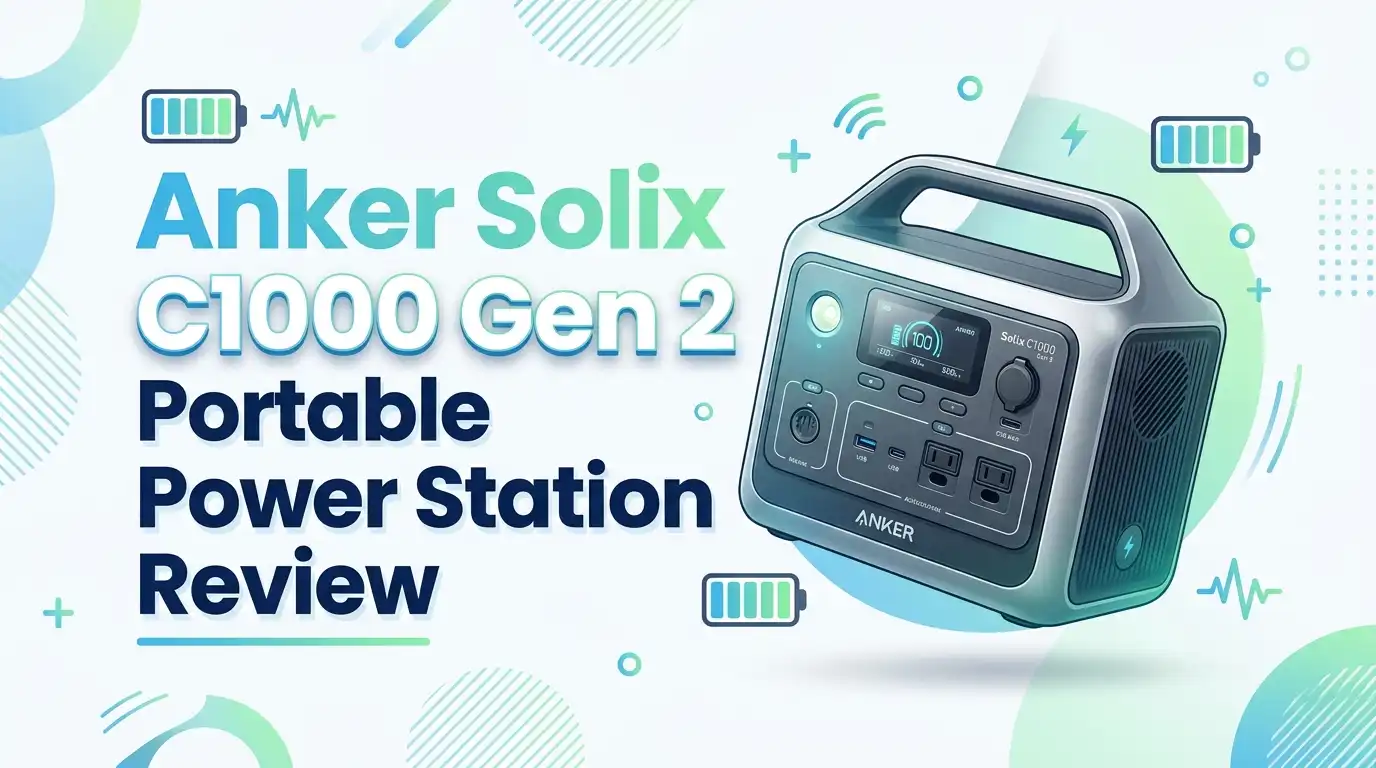
The screen is the part I warmed to fastest. Anker ditched their old cluttered display for a clean, color-accented readout. At a glance, I could see input watts, output watts, and remaining battery percentage.
It recesses slightly into the body, which cuts glare in sunlight. There is even a clock screensaver mode you can switch on through the app.
The Anker app unlocks the features that matter. The UltraFast charging toggle lives here, not on the unit itself. You also control screen timeout and charge limits. App connectivity stayed stable for me over weeks, though one owner noted firmware updates require you to be physically present to reboot it.
Top 3 Alternatives for Anker Solix C1000 Gen 2
If the Anker isn’t quite right, these three are worth comparing before you decide.

Last update on 2026-09-09 / Affiliate links / Images from Amazon Product Advertising API Some of the links on this website are affiliate links, which means that at no additional cost to you, I earn a commission if you click through and make a purchase. I only recommend products and services that I believe will add value to my readers. Thank you for your support!
EcoFlow DELTA 3 Plus Portable Power Station

Last update on 2026-09-09 / Affiliate links / Images from Amazon Product Advertising API Some of the links on this website are affiliate links, which means that at no additional cost to you, I earn a commission if you click through and make a purchase. I only recommend products and services that I believe will add value to my readers. Thank you for your support!
Jackery Explorer 1000 v2 Portable Power Station

Last update on 2026-09-09 / Affiliate links / Images from Amazon Product Advertising API Some of the links on this website are affiliate links, which means that at no additional cost to you, I earn a commission if you click through and make a purchase. I only recommend products and services that I believe will add value to my readers. Thank you for your support!
BLUETTI AC180 Portable Power Station
Charging Speed: The Headline Feature
This is where the C1000 Gen 2 earns its hype. Anker claims a Guinness World Record for the fastest charging in the 1,024Wh class. I was skeptical of the marketing, then I tested it.
With UltraFast mode active, mine charged from 0% to 100% in about 47 minutes. That beats even Anker’s own stated 49-minute figure. The standard rate is 1,200W, and UltraFast pushes it to 1,600W at the wall.
Why does this matter? Because backup power is useless if you forgot to charge it. A storm warning gives you about an hour. This unit can go from dead to full in that window. I topped it up during a quick lunch break before a forecasted outage and had a full charge ready.
Real-World Runtime and Output
Numbers on a spec sheet are one thing. Living with the unit is another. I ran a mid-size fridge, a laptop, a router, and LED lights during a four-hour outage and barely dented the battery.
The 2,000W continuous rating handled my microwave in short bursts. Power tools with high startup draw also worked thanks to the 3,000W surge. A measured 86% efficiency means little energy is wasted as heat.
The 13.8W idle draw impressed me most. You can leave the inverter on for days, ready to catch an outage, without watching the battery vanish. For backing up an intermittent load like a fridge, that low draw is exactly what you want.
Ports and Connectivity
Ten ports cover almost any scenario. You get the online Gen 2 version’s five AC outlets, which is one more than the in-store C1000X model. That extra plug is a real perk.
On the USB side, there are three USB-C ports, two rated at a fast 140W. This charges modern laptops and cameras at full speed without a separate brick. A single USB-A port rounds out the set.
The 12V car socket is a thoughtful keep. Many newer power stations cut this, but it lets you run DC camping gear and fridges efficiently. My one gripe: the AC outlets sit a little cramped. Two bulky chargers crowd each other.
Solar Charging Performance
For off-grid users, solar input is the deciding factor. The C1000 Gen 2 accepts up to 600W of solar. That is strong for a battery this size.
In my testing under good sun, it reached a full charge in roughly 1.5 to 2 hours. That is fast enough to run a meaningful camping cycle, charging by day and powering lights and devices by night.
Remember, you must buy the solar cable separately. The panels are an add-on too. Pair it with a quality 200W or 400W folding panel and you have a quiet, self-sustaining setup for weekend trips. It will not power an off-grid cabin alone, but for mobile and emergency solar, it punches well above its weight.
Who This Power Station Is For
I want to be direct about fit. The C1000 Gen 2 shines for a specific crowd. Renters who can’t install a backup generator will love the plug-and-play nature.
Weekend campers get a light, fast-charging companion that runs a portable fridge and charges cameras. Remote workers in outage-prone areas can keep a laptop and router alive through short blackouts.
People in small homes or apartments who want fridge-and-essentials backup are the sweet spot. The fast recharge means it recovers quickly between grid hits. If your needs are modest and portability matters more than raw capacity, this is a near-perfect match.
Who Should Skip It and the Honest Flaws
No unit is flawless, and this one has real gaps. The biggest is the lack of an expansion battery option. You are locked into 1,024Wh forever. Serious preppers who want to double runtime later cannot do it here.
The missing built-in light stung during camping. Anker’s older models had a handy light bar. Fumbling for ports in the dark, I missed it badly.
Some owners report only one of the two cooling fans spins, even under load. It seems to be temperature-based behavior, not a fault, but it caused confusion. Skip this unit if you need whole-home backup, expandable capacity, or built-in lighting for off-grid nights.
My Final Verdict
After weeks of real use, the Anker Solix C1000 Gen 2 is one of the easiest power stations to recommend in the 1kWh class. The charging speed is not a gimmick. It genuinely changes how you use a backup battery.
At around $449, the value is excellent for a top-tier brand. You get strong output, a low idle draw, a clean display, and superb customer support. The flaws (no light, no expansion) are real but narrow.
If you want fast, portable, fuss-free backup for a small home or camping, buy the Gen 2 version for the extra outlet. If you need expandable, whole-home power, look at something larger. For most people, this hits the sweet spot.
Frequently Asked Questions
How long does the Anker Solix C1000 Gen 2 take to charge?
Using the UltraFast mode in the Anker app, it charges from 0% to 100% in about 47 to 49 minutes at 1,600W. The standard rate is slower at 1,200W. Solar charging at 600W takes roughly 1.5 to 2 hours in good sun.
Can it run a refrigerator?
Yes. The 2,000W continuous output easily handles a full-size or mid-size fridge. With the 1,024Wh battery, expect several hours to most of a day of fridge runtime, depending on the unit’s efficiency and how often the compressor cycles.
Does it have an expansion battery option?
No. This is one of its main limitations. You cannot add an external battery to increase runtime. You are committed to the internal 1,024Wh capacity. If you want expandable storage, look at the original Gen 1 or larger Anker models.
Is it safe to use indoors?
Yes. It uses a LiFePO4 battery with no fumes, fuel, or emissions. This chemistry is far more stable and fire-resistant than older lithium cells. It is built for indoor backup, unlike gas generators which must stay outside.
How is the self-discharge during storage?
Excellent. One long-term owner left it unplugged for three weeks and it held 100%. LiFePO4 cells retain charge very well. For long-term storage, many experts suggest keeping it around 50%, though this chemistry tolerates full-charge storage better than older batteries.
What is the difference between the Gen 2 and the C1000X?
They are nearly identical. The online Gen 2 has five AC outlets, while the in-store C1000X has four. There are minor color and display differences. At the same price, the Gen 2 is the better buy for that extra plug.
Does it come with solar panels or a solar cable?
No. The box includes the AC and car charging cables only. You must purchase solar panels and the solar cable separately. Pair it with a 200W to 400W panel to reach its 600W solar input ceiling.

Hi, I’m Marie Bennett, the founder of PackSmart.blog.
I write about travel essentials and Amazon gear reviews to help you pack smarter and travel lighter.
From must-have accessories to space-saving gadgets, I test and share what truly works on the road.
My mission is to make every trip stress-free and organized for travelers like you.
Join me as I explore smarter ways to travel—one bag at a time.