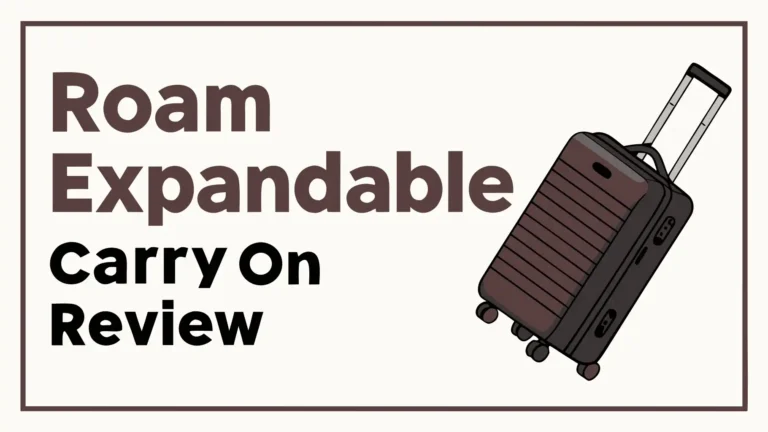
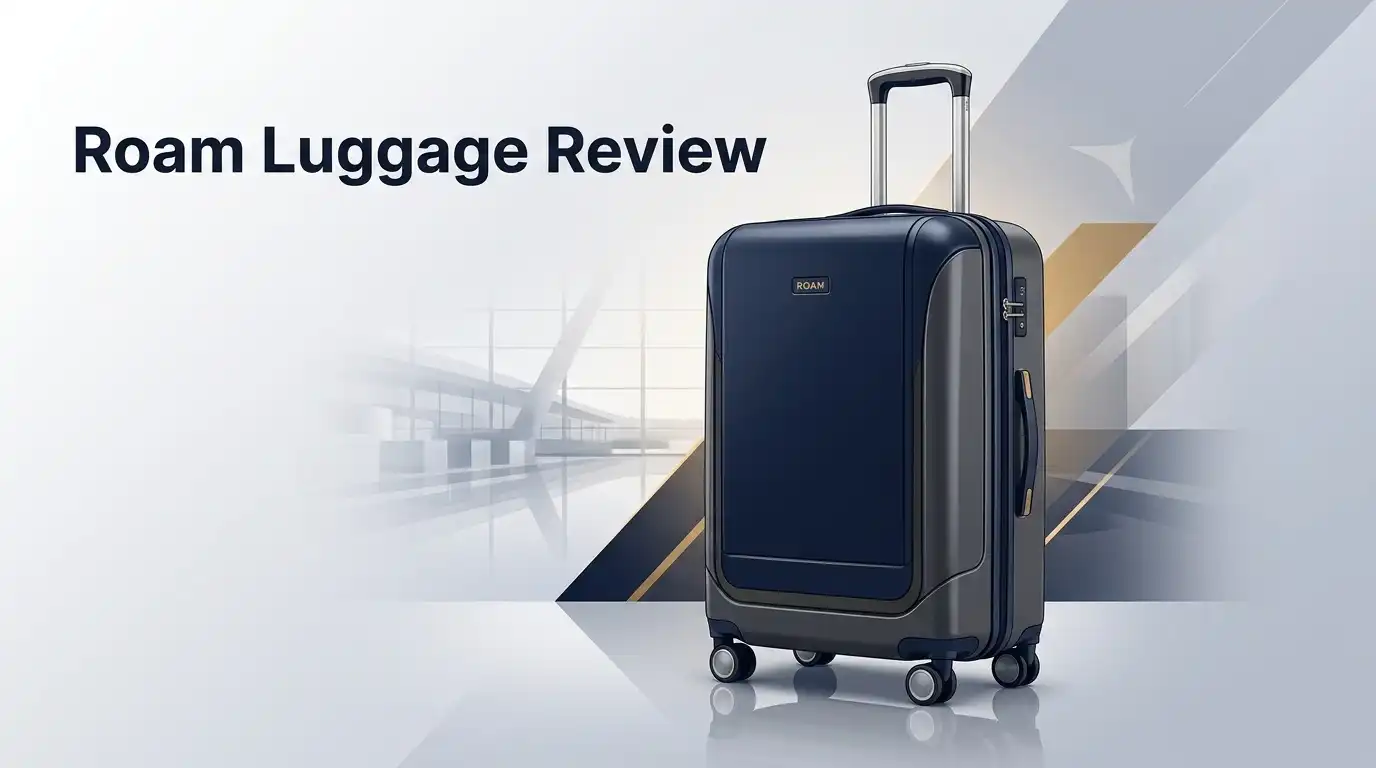
Roam Luggage Review 2026: Worth It?
Roam Luggage sits in a strange spot. It costs as much as Rimowa, it looks like nothing else on the baggage carousel, and almost nobody in your boarding line has heard of it.
I spent months tracking how these cases actually hold up. I read owner complaints, warranty fine print, long term traveler reports, and the specs Roam publishes for every size.
This review covers the good, the annoying, and the parts Roam quietly does poorly. If you are about to spend $595 on a suitcase, you deserve the full picture first.
In A Nutshell:
- Roam builds every case to order in Georgia, USA. You pick the shell, front, back, zipper, wheels, handles, and trim. The brand was founded by two former Tumi executives, Charlie Clifford and Larry Lein, so the engineering pedigree is real.
- Prices run $595 for the Carry On up to $850 for the Large Check In Expandable. There is no discount for choosing a plain color, which means you pay for customization whether you use it or not.
- The hardware is genuinely top shelf. Hinomoto ball bearing wheels, YKK water resistant zippers, a four stage aluminum trolley handle, 50% recycled polycarbonate shells, and dual internal compression boards.
- Weight is a real strength. The Carry On lands near 7 lbs and the Check In Expandable near 10.2 lbs, which is light for a hardside case with this much hardware.
- The glossy finishes scratch fast. Cosmetic damage is excluded from the lifetime warranty, so a gloss shell in a dark color will show airport life quickly.
- Some owners report broken handles and slow support replies. The lifetime limited warranty covers function, not looks, and repair turnaround can stretch out.
What Is Roam Luggage?


Last update on 2026-08-26 / Affiliate links / Images from Amazon Product Advertising API Some of the links on this website are affiliate links, which means that at no additional cost to you, I earn a commission if you click through and make a purchase. I only recommend products and services that I believe will add value to my readers. Thank you for your support!
Roam launched in 2018 as the first premium luggage brand built entirely around customization. You do not pick from twelve colorways. You design your own.
The founders came straight from Tumi. Charlie Clifford started Tumi in 1975. Larry Lein spent decades there as an executive, and that history shows up in the parts list.
Every case is hand assembled in the United States after you order. Production usually takes a few days, and the welcome card inside is signed by the person who built your bag.
The lineup is simple. You get a Carry On, a Large Carry On, expandable versions of both, a Check In, a Large Check In, plus totes and small leather goods.
Roam is not sold on Amazon or in department stores. You buy direct from roamluggage.com, which keeps the customization tool in play but removes any chance of a marketplace discount.
The brand positions itself as investment luggage. Larry Lein once said Roam aims to be the BMW of luggage, and the pricing follows that ambition closely.
One important note for 2026 shoppers. Roam updated its shells to 50% recycled polycarbonate and refined its wheel assembly, and long term owners on Reddit confirm the newer cases roll noticeably better than early production units.
That matters. If you read a harsh review from 2021, it may not describe the bag shipping today.
Unboxing The Roam Carry On
The box arrives plain and flat. Inside, the case sits in a soft dust bag, usually blue, with the smaller items nested inside the shell to save shipping volume.
The first thing you notice is the smell of new polycarbonate and the weight, or the lack of it. Lifting a 7 lb carry on out of a box feels wrong in a good way.
Your monogram sits on the back panel if you ordered one. Owners report it is subtle and clean, though a few have found the emboss slightly off center.
Open the lid and you find two compression panels, a zippered mesh divider, an antimicrobial lining, and a garment board on the larger sizes. There are more compartments here than in most cases twice the price.
The handle telescopes with a firm click through four stages. There is very little wobble, which is the fastest way to judge a trolley handle in a store.
The wheels are the showpiece. Set the case on a hard floor and it glides with a low hum instead of the usual plastic rumble, and it will roll away on its own if the floor tilts.
Small details land well. The TSA lock dials turn smoothly, the zipper pulls feel weighty, and the embossed shell pattern hides light scuffs better than a flat panel would.
The whole experience feels premium without theater. No magnetic flaps, no ribbon, just a well built bag in a bag.
Design And Customization Options
This is the reason to buy Roam. The online designer lets you change six or more parts of the case, and the 3D preview spins so you can see every angle.
You choose the shell color, front panel, back panel, zipper tape, zipper bumper, wheels, top handle, and side handle. Some collections add trim and hardware finish choices.
Roam worked with a professional colorist on the palette. The result is a small set of colors that mix well, which means it is genuinely hard to design an ugly case.
Three levels of help exist. Preset designs get nervous shoppers moving, a simplified flow handles the middle ground, and full custom mode gives you every single component.
There is one gotcha worth knowing. Picking a trim color can also change your wheel color, and light wheels show scuffs within a few trips.
Most experienced owners pick black wheels no matter what the rest of the case looks like. It is the single best design decision you can make here.
The tool has gaps. You cannot save and compare multiple designs side by side, and there are few real photos of each color under normal light.
Screen color also lies a little. Several owners report their shell looked deeper or brighter in person than on the preview, which is a real risk on a nonreturnable feeling purchase.
Roam does offer a 100 day trial, which softens that risk considerably. Still, order early rather than the week before a trip.
Travelpro Platinum Elite Carry On Spinner
I include this one because it is the honest cross shop for a Roam Carry On, and it costs a fraction of the price.
The Platinum Elite is soft sided, expandable by two inches, and built around a self aligning wheel system that flight crews have trusted for years. It carries a USB port, a built in suiter, and a lifetime warranty of its own.
Access is faster than any hardside case. You can unzip the top pocket at a gate and pull out a laptop without opening the main compartment.
The tradeoff is protection and looks. Fabric absorbs dirt, offers less crush resistance, and no version of this bag will ever be uniquely yours.
Roam wins on materials, silence, and identity. Travelpro wins on price, repair network, and quick access. Choose based on how often you fly and how much you care about the object itself.
Weight is close. The Platinum Elite carry on sits near 7.9 lbs, so the Roam is actually lighter despite the hard shell.
If your travel is mostly domestic work trips with tight overheads, the Travelpro is the sensible pick. If your suitcase doubles as a design object you keep for fifteen years, keep reading.
Top 3 Alternative for Roam Carry On

Last update on 2026-08-26 / Affiliate links / Images from Amazon Product Advertising API Some of the links on this website are affiliate links, which means that at no additional cost to you, I earn a commission if you click through and make a purchase. I only recommend products and services that I believe will add value to my readers. Thank you for your support!
Samsonite Freeform Hardside Carry On Spinner

Last update on 2026-08-28 / Affiliate links / Images from Amazon Product Advertising API Some of the links on this website are affiliate links, which means that at no additional cost to you, I earn a commission if you click through and make a purchase. I only recommend products and services that I believe will add value to my readers. Thank you for your support!
LEVEL8 Rolling Carry On Luggage

Last update on 2026-08-28 / Affiliate links / Images from Amazon Product Advertising API Some of the links on this website are affiliate links, which means that at no additional cost to you, I earn a commission if you click through and make a purchase. I only recommend products and services that I believe will add value to my readers. Thank you for your support!
DELSEY Paris Helium Aero Carry On Spinner
Build Quality And Materials
The shell uses 50% recycled polycarbonate, extruded and formed in the United States. Polycarbonate flexes under impact and returns to shape, which is why premium brands use it instead of cheaper ABS.
The shape itself does work. Roam engineered curves and ribs that raise breaking strength, which let the team reduce wall thickness and save weight.
Zippers are YKK with a water resistant coating. That is the same grade you find on much more expensive European cases.
The trolley handle is internally mounted aluminum with ribbed extrusion. It feels like a camera tripod leg, and it resists the side to side wobble that ruins cheap cases within a year.
Locks are TSA approved with three dials. Nothing exotic, but they line up correctly and the dials do not slip.
The interior earns its keep. An antimicrobial lining guard reduces odor on long trips, and the mesh dividers hold shape instead of sagging.
Here is the honest limit of all this. Polycarbonate is strong but it is still plastic, and a gloss finish will scratch when a baggage handler drags it across concrete.
Owners who check their Roam cases regularly report scuffs on the corners within a handful of trips. Matte and textured finishes hide this far better than gloss.
Buy a shell cover if you check your bag often. It costs little and it protects the one thing the warranty will not fix.
Wheels, Handle, And Rolling Feel
Roam uses Hinomoto wheels with sealed ball bearings. These are Japanese made and they are the same wheels found on high end Japanese and European luggage.
The difference is obvious in the first ten feet. Instead of a rattle, you get a low hum, and the case tracks straight instead of pulling sideways.
Reviewers repeatedly mention the same funny problem. The case rolls away on its own if the floor has any slope at all.
One owner on Reddit said the wheels on the newer cases legitimately changed my life compared with the older version. Roam clearly revised this part, and it shows.
Smaller wheels do have a ceiling. Hardside spinner wheels struggle on cobblestone, gravel, and broken sidewalks, so Roam is a poor choice for rough travel.
The handle has four height stops, which helps if you are short or tall. The button action is firm and stays locked under load.
Overhead lifting is where the low weight pays off. Petite travelers report getting a fully packed Roam carry on into a bin without a struggle, which is not true of most 9 lb hardside cases.
One design gap remains. The trolley handle grip is plain and cannot be customized, which feels like a miss on a bag built around personalization.
Packing Space And Interior Compression
The dual compression system is my favorite feature in the whole lineup. Each side has a frame and strap panel that presses clothes flat against the shell.
The result is simple. Your packing stays exactly where you put it, even after a rough flight and a taxi ride.
Shirts wrinkle less. Fragile items do not shift and knock together. Once you use a real compression board, going back feels careless.
Capacity is competitive. The Check In Expandable runs roughly 26 by 17.5 by 12.5 inches and adds about 34% more volume when you open the expansion zipper.
Expansion behaves well. Roam designed the expanded shape to resist tipping, so the case does not become top heavy when full.
Reviewers who normally overpack report fitting two full weeks of clothing plus shoes and a sketchbook in a single expandable carry on. That is compression doing its job.
There is one weak point. The compression panel mounting hardware is less refined than the rest of the case, and it looks slightly industrial next to the polished exterior.
Hardside access is also slower by nature. You must lay the case flat and open the whole lid, which is awkward in a cramped hotel room or a middle seat row.
If you want to grab a laptop at the gate, buy a front pocket model or carry a separate tote.
What Roam Does Not Do Well
An honest review needs this section, so here it is without softening.
The gloss finishes scratch easily and the warranty excludes cosmetic damage by name. Scratches, dents, dings, scuffs, stains, and color changes are all on you.
Handle failures show up in owner complaints. One traveler reported both handles ripping on a $500 plus check in bag, which is exactly the part you touch most.
Customer service is inconsistent. Some owners praise fast replacements, others describe long waits and repeated follow ups before anything moves.
Pricing punishes plain taste. A stock color Carry On costs the same $595 as a fully custom one, so you subsidize a feature you may never use.
There is little technical innovation beyond color. No integrated scale, no laundry compartment, no removable packing cubes, nothing you cannot find elsewhere.
Rough terrain is a weakness. The wheels are small, the shell is rigid, and neither suits gravel roads or long walks on old European streets.
Availability is limited. No Amazon listing means no next day delivery, no marketplace returns, and no chance to inspect the case in person before buying.
Resale value is also unclear. A heavily customized bag with your initials on it is harder to sell than a plain black Samsonite.
None of these kill the product. They just explain why Roam is not the right pick for everyone at this price.
Pros And Cons
Pros
- Real customization across shells, panels, zippers, wheels, handles, and trim, with a 3D preview and preset designs for people who freeze up.
- Hinomoto ball bearing wheels that roll silently and track straight, easily among the best wheels on any consumer suitcase.
- Very light for a hardside case, around 7 lbs for the Carry On and 10.2 lbs for the Check In Expandable.
- Dual internal compression boards that hold clothing in place and cut wrinkling on long trips.
- Hand assembled in the USA with a signed maker card, plus a lifetime limited warranty on function.
- A 100 day trial period that lets you actually fly with the bag before committing.
- Premium components throughout, including YKK water resistant zippers, TSA locks, and a four stage aluminum trolley handle.
Cons
- Expensive, with prices running from $595 to $850 and no discount for skipping customization.
- Gloss shells scratch quickly and cosmetic damage is specifically excluded from the warranty.
- Scattered reports of handle failures and slow warranty support.
- Small wheels and a rigid shell make it poor for cobblestone, gravel, or off the beaten path travel.
- Hardside access is slow, and there is no laptop pocket on standard models.
- Not available on Amazon, so no fast shipping or easy marketplace return.
- No standout technical innovation beyond the customization tool.
Price, Warranty, And Return Policy
Roam prices sit in premium territory. The Carry On runs $595, the Large Carry On $650, the Carry On Expandable $650, and the Large Carry On Expandable $695.
Checked sizes climb from there. The Check In is $725, the Check In Expandable $775, the Large Check In $775, and the Large Check In Expandable $850.
Sales exist but they are modest. Roam runs occasional $50 off codes and seasonal promotions, and signing up for email usually unlocks a first order discount.
The warranty is lifetime and limited. It covers defects in materials and workmanship, plus functional damage from airline handling on many components.
Read the exclusions carefully. Cosmetic damage, normal wear, and color change are not covered, which is a common source of frustration.
The 100 day trial is the genuinely useful part. You can fly with the case, decide it is not for you, and send it back within that window.
Payment plans are available through installment providers, which spreads a $775 case across several payments if that helps your budget.
Compare that to the field. Away and Monos sit in the $275 to $450 range with lifetime warranties, and Rimowa aluminum starts well above $1,000.
Roam lands between the direct to consumer crowd and the luxury names. You pay for USA assembly, better wheels, and a bag nobody else owns.
Roam vs Away vs Monos vs Rimowa
Away built the modern luggage playbook with clean design and honest pricing. Its carry on costs roughly half a Roam and comes with a lifetime warranty, but the wheels and handle feel a step below.
Monos sits close to Away on price with a slightly more refined interior and a vegan leather trim. It also runs frequent sales, which Roam does not.
Rimowa plays a different game. Grooved aluminum, serious brand recognition, and a price that starts around double a Roam Carry On, with the same scratch problem plus dents.
Tumi deserves a mention because of the family tree. Tumi hardside cases match Roam on hardware quality and beat it on service network, though most cost more and none are customizable.
Here is the practical read. Roam wins if you want top tier rolling hardware, low weight, USA assembly, and a case that is visually yours.
The others win on price, retail availability, or brand signaling. None of them let you pick your zipper color.
Choose Roam for the wheels and the design tool. Choose Away or Monos if $595 makes you wince.
Who Should Buy Roam Luggage
Frequent flyers get the most value here. If you fly monthly, the wheels, the handle, and the compression system will improve every single trip.
Design minded travelers will love the ordering process. Building a case that matches your taste is genuinely fun, and the attachment lasts.
Carry on only packers benefit from the low weight and expandable options. Fitting two weeks of clothing into one bag is realistic with these compression panels.
Gift buyers have a strong option. A monogrammed custom case is a memorable graduation or wedding present, assuming you know the recipient’s taste.
Skip Roam if you travel rough. Backpackers, overland travelers, and anyone dragging bags across gravel should buy soft luggage with bigger wheels.
Skip it if you check bags constantly and hate scratches. The warranty will not help, and a matte finish only delays the problem.
Skip it if budget is tight. A $150 Samsonite Freeform will get your clothes to Denver and back just fine.
How To Keep A Roam Case Looking New
A few habits make a real difference over years of use.
Order black wheels regardless of your color scheme. Light wheels pick up airport grime within one trip and never fully clean up.
Buy a fitted shell cover for checked travel. It costs a small fraction of the bag and absorbs the abuse the warranty ignores.
Choose matte or textured finishes if you check bags. Gloss looks incredible on day one and shows every scratch by month three.
Wipe the shell with a soft damp cloth and mild soap. Avoid solvents, which cloud polycarbonate permanently.
Store the case unlocked and slightly open. This keeps the lining fresh and stops odor from building between trips.
Rinse the wheels after beach or salt exposure. Sealed bearings last a long time, but grit shortens their life fast.
Register your purchase so warranty claims move faster if a handle or wheel fails later.
Final Verdict: Is Roam Luggage Worth It In 2026?
Roam makes a very good suitcase with an unusually strong wheel and handle package, wrapped in the best customization tool in the category.
The engineering credibility is real. Two Tumi veterans built this, and the parts list proves it.
The flaws are also real. Gloss finishes scratch, cosmetic damage sits outside the warranty, support quality varies, and you pay full price even for a plain color.
My take: Roam is worth it for frequent flyers who want a lifetime carry on that feels personal. It is not worth it for occasional travelers who fly twice a year.
If you want the experience without the risk, use the 100 day trial. Fly with it, check it once, and decide honestly.
If $595 feels heavy, the Travelpro, Samsonite, and LEVEL8 options above will move your clothes just as reliably for far less money.
FAQs
Is Roam luggage made in the USA?
Yes. Roam hand assembles every case in its Georgia facility after you place the order, and the polycarbonate shells are extruded and formed in the United States.
How much does Roam luggage cost?
Prices run from $595 for the Carry On to $850 for the Large Check In Expandable. There is no price difference between a stock color and a fully custom design.
Does Roam luggage scratch easily?
Gloss shells do scratch. Matte and textured finishes hide marks better, and cosmetic damage is not covered by the warranty, so a shell cover is a smart addition.
Is Roam luggage sold on Amazon?
No. Roam sells only through its own website, which is where the customization tool lives. Similar sounding brands on Amazon are unrelated companies.
What does the Roam warranty cover?
It covers defects in materials and workmanship plus functional damage for the life of the product. It excludes scratches, dents, scuffs, stains, color change, and normal wear.
How long does a Roam order take to arrive?
Assembly usually takes a few days, then standard shipping follows. Most customers receive their case within one to two weeks, though custom orders can run longer in peak season.
Is the Roam Carry On airline approved?
Yes. The standard Carry On measures about 22 by 14 inches with the wheels included, which fits major US carrier cabin limits. Some international budget airlines use smaller allowances.
Can I return Roam luggage after using it?
Yes. Roam offers a 100 day trial, so you can travel with the case and return it within that window if it is not right for you.

Hi, I’m Marie Bennett, the founder of PackSmart.blog.
I write about travel essentials and Amazon gear reviews to help you pack smarter and travel lighter.
From must-have accessories to space-saving gadgets, I test and share what truly works on the road.
My mission is to make every trip stress-free and organized for travelers like you.
Join me as I explore smarter ways to travel—one bag at a time.